





 15 Minutes


Key Takeaways
- Cozy games are emotional reset tools, not just entertainment. Players across the globe turn to cozy games to manage stress, improve mood, and enjoy low-pressure play.
- Cultural context shapes cozy preferences. Each country brings its own emotional blueprint to cozy gaming. Some players crave autonomy and nostalgia, while others seek ambiance and mood.
- Brands that succeed in this space will prioritize how players want to feel—whether that’s soothed, productive, nostalgic, or creatively free.
Five Countries. Thousands of Players. One Cozy Trend.
Explore what our omnibus study reveals about mood, motivation, and market-specific magic in 2025.
Cozy gaming is a genre of games defined by calm, feel-good play, where relaxation, creativity, and emotional comfort take center stage. It’s not about high scores or fast reflexes, but about how the games make us feel, like a digital version of knitting by the fire or sipping a warm cup of tea.
To explore this growing movement, we ran an in-depth omnibus survey across the US, UK, France, Spain, and Germany. From motivations and memory to mood management and unmet needs, this article unpacks the emotional landscape of cozy gaming, and how it shifts by market.
Why Cozy, Why Now?
There’s a quiet revolution happening in adult gaming. While much of the industry races toward speed, stakes, and spectacle, a parallel movement is leaning into low-pressure, emotionally resonant play. Cozy games are rising not just in downloads, but in cultural relevance, becoming a kind of digital comfort for overstimulated minds.
And why are adults playing them? The biggest reason: stress relief. Over 50% of players across markets say they turn to cozy games to “switch off” from everyday anxiety. Many also say these games help improve their mood or offer an easy way to get lost in a calming, imaginative world. Forget leaderboards and fast reflexes; these games invite you to breathe, build, and exist at your own pace.
But “cozy” means different things to different people. And that’s exactly what our research set out to explore.
Why People Play Cozy Games: Motivation Meets Emotion
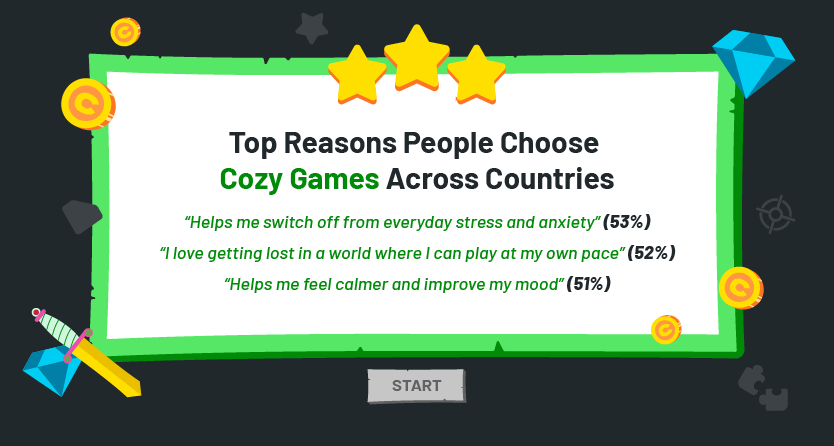
We began by asking players how they define their style of play. Across markets, relaxation and escapism were leading drivers. When asked why cozy games appeal, the top reasons across countries included:
- “Helps me switch off from everyday stress and anxiety” (53%)
- “I love getting lost in a world where I can play at my own pace” (52%)
- “Helps me feel calmer and improve my mood” (51%)
While these were the top reasons, each market adds its own emotional flavor to the cozy experience.
In the US, 44% of gamers play to relax and 41% to escape daily stress, treating cozy games like digital wind-down tools. Over half (57%) say cozy games help manage everyday stress, while 53% say they lift their mood—more therapy-lite than competitive challenge.
In the UK, escapism slightly edged out relaxation (45% vs. 43%), and 55% say they enjoy playing at their own pace. British players lean into cozy games as a soft rebellion against productivity culture—a moment of gentle autonomy in a high-pressure world.
France mirrors these motivations (44% relaxation, 41% escape), but stands out emotionally. A significant 51% say cozy games remind them of childhood, and 13% want games that adapt to their mood—suggesting ambiance and emotional resonance matter more than gameplay mechanics.
Spain shows a more even spread of motivations, with a slight preference for social connection (13%). Players here crave a balance: 54% say cozy games help relieve stress, and 51% appreciate feeling productive without pressure. It’s calm meets progress, with a social twist.
In Germany, 43% play to challenge themselves—the highest among all markets—highlighting that cozy doesn’t mean aimless. For German players, structure supports relaxation: 53% enjoy non-linear play, 52% feel productive while doing so, and 12% say they play when they want something simple. Their cozy ideal? Calm, but crafted.
Challenge… but Make It Cozy
Not all soft games are cozy, and not all players agree on what belongs in the genre.
While most embrace relaxation, 17% in Spain and Germany want more challenge in their cozy experiences, while only 10% in France selected this. This contrast opens the door to define cozy not just by what it is, but what it’s not.
These preferences reflect a mix of emotional needs, personal play styles, and cultural influences, but what unites cozy gamers across borders? The next layer of our analysis looked at what people feel cozy games do for them, and the answers were surprisingly consistent.
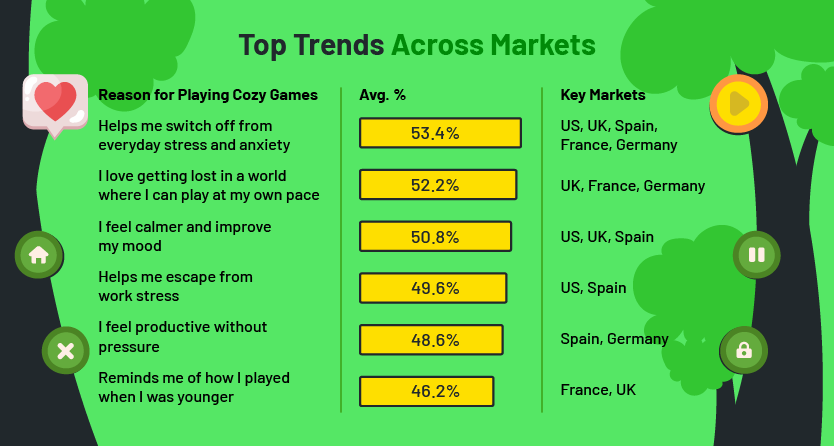
What Cozy Gamers Want and How Brands Can Deliver
Cozy gaming isn’t just a trend—it’s a mindset. And understanding these preferences helps brands design more meaningful, memorable game experiences:
- Cozy games = emotional reset. With high scores for helping players “switch off from stress,” cozy games are a valuable tool for emotional well-being—especially in the US, UK, France, and Spain.
- Let players set the pace. Non-linear play is highly valued, making “play at your own pace” mechanics a hit across the UK, France, and Germany.
- Quietly productive play is in. Players in Germany and Spain are drawn to games that feel productive without the pressure.
- Nostalgia hits the mark. Games that remind players of childhood resonate strongly in France and the UK—tap into that retro magic.
- Keep it kind. A non-toxic, non-competitive environment is a must for players in the US and UK who prefer low-pressure experiences.
- Make it easy to dip in and out. Seamless, short-session play is key for UK and German gamers who value flexibility.
When and How Often People Play
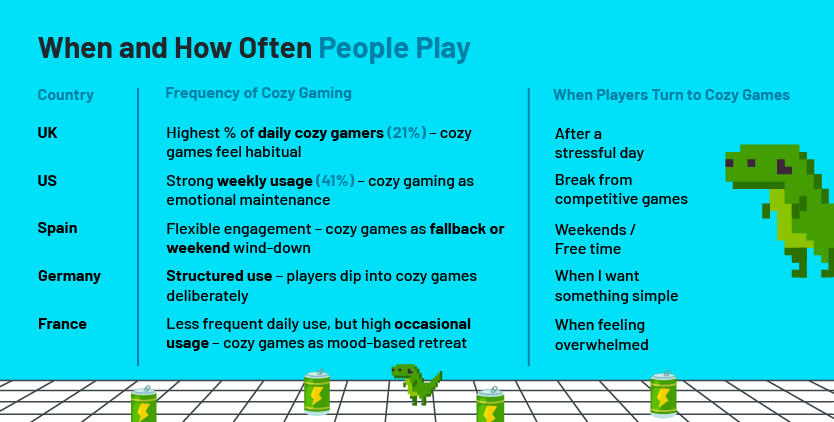
Cozy gaming isn’t one-size-fits-all. In some markets, it’s part of a daily rhythm—like a morning coffee or evening TV show. In others, it’s a weekend ritual, saved for slower, more intentional moments.
- In the UK, it’s part of the everyday — 1 in 5 players say they play cozy games daily, the highest share across countries, and 40% turn to it after a stressful day. It’s a go-to decompression tool.
- In the US and Spain, most players dip in several times a week, especially as a way to unwind after work or during downtime, 33% in each country say they play to relax at the end of the day.
- In France and Germany, cozy gaming tends to happen less frequently but with more intention. Players often save it for quieter moments, like slow Sundays or peaceful evenings.
- French players (32%) often log in during quiet weekend hours, while 12% of German players say they turn to cozy games when they want something simple—suggesting a demand for ease and clarity.
The Comfort Behind the Clicks
Understanding these emotional and situational rhythms reveals what cozy games are really replacing—stressful routines, overstimulation, or the grind of competitive play. They offer a softer kind of screen time, matched to players’ moods and moments.
These patterns hint at how cozy games are used. In some countries, they’re like a morning coffee or evening TV show — a regular comfort. In others, they’re more like a Sunday walk: intentional, immersive, and best enjoyed when there’s time to spare. Understanding these habits helps developers meet players where they are, whether that’s once a day or once a week.
What Does this Mean for Brands?
Time it right: Markets like the UK and US are primed for daily logins, episodic content, and cozy challenges that fit into everyday life.
Design for intention: In France and Germany, players seek quality over quantity. Prioritize immersion, polished UX, and low-pressure play loops.
Embrace the mood: Spain’s flexible style invites cozy games that adapt to time and feeling—gentle restarts, soft goals, and seamless session transitions.
Highlight the contrast: Position cozy games as the calm alternative to high-stakes, high-stress entertainment—perfect for emotional recovery and mindful escape.
Playing While Doing Other Things
Nearly 40% of players in the US and UK say they like to play cozy games while doing something else, like listening to music or watching TV.
This adds another layer to cozy: it’s not always the main event. Sometimes it’s background ambiance. This makes cozy games part of a multitasking lifestyle, like scented candles for your screen!
What Players Want Next
We asked what would make players even more interested in cozy games, and the answers revealed more than preferences. They uncovered tension points: where players feel the genre isn’t delivering enough, and where their expectations are evolving.
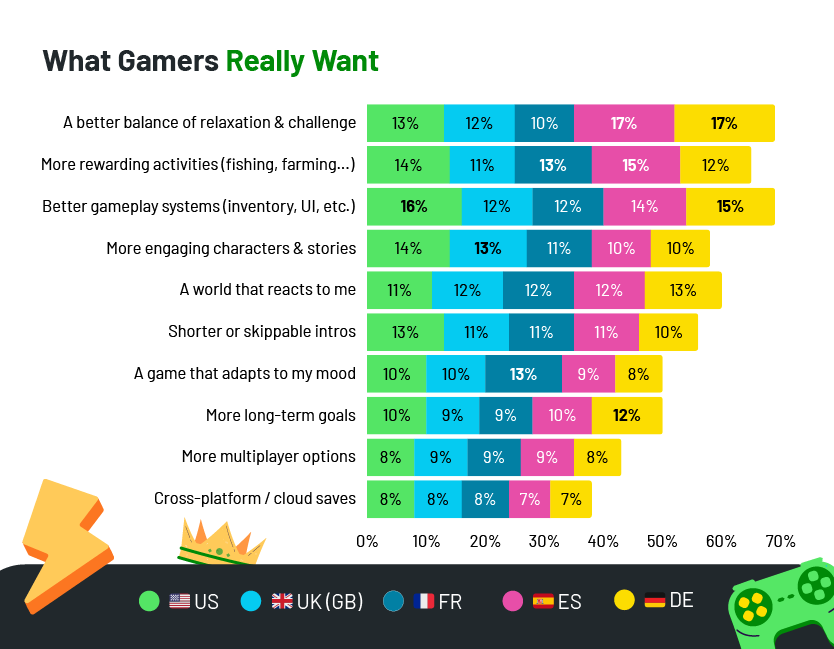
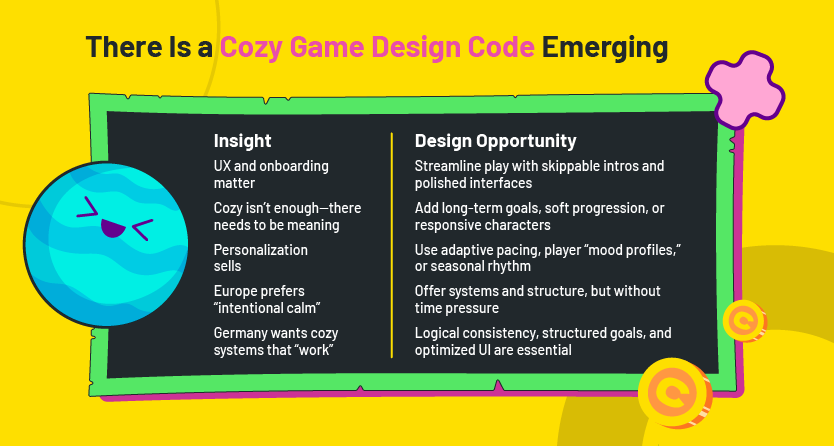
- In the US, 16% want better gameplay systems, signaling clear frustration with clunky interfaces or mechanics that feel dated. But it’s not just about polish, it’s about flow. Players want cozy experiences to feel smooth, intuitive, and pleasurable from the first click.
- In France, 13% wish for a game that “adapts to my mood”, an almost cinematic desire for digital environments that shift gently alongside their emotional state. This suggests a market primed for ambient features and narrative elasticity.
- Spain and Germany both rank highest for wanting a better balance between “relaxation and challenge” (17% each), revealing a shared appetite for cozy games that aren’t passive but purposeful. Games that offer gentle progression, small wins, and a sense of momentum without stress.
- And the UK is asking for more. 13% want richer stories, 12% want dynamic worlds, and another 12% want smoother systems. Together, this sketches out a portrait of a player base looking for evolution—a next-gen cozy, soft in tone but layered in depth.
There’s no universal wishlist. But there is a cozy design code emerging.
Childhood Memory as Cozy Blueprint
Perhaps the most revealing insight came from an open-ended question: “If cozy games could bring one childhood experience into a digital world, what would it be?”
Here, markets offered wildly distinct emotional blueprints, each one a small window into cultural nostalgia, childhood environments, and what “comfort” really looks like.
- In the US, responses were media-literate and individualist: “building a treehouse,” “Saturday morning games,” “playing grown-up.” Americans tap into a solo creative nostalgia. Treehouses are symbolic of independence and personal space, often romanticized in 1990s and 2000s media. Saturday morning cartoons and gaming suggest comfort rituals, deeply embedded in screen culture. There´s a hint at a desire to simulate adult-like systems (errands, shops, homes) in a low-pressure way. Brands should see this as a green light for cozy mechanics that mirror everyday adult routines, but reframed as manageable, peaceful tasks.
- In the UK, it was nostalgia-fueled and colorful: “building dens,” “Sonic,” “Viva Piñata.” Responses showed a playful mix of make-believe and console nostalgia. “Building dens” is a quintessential British childhood memory (blankets, cushions, secret hideouts). The repeated mentions of Viva Piñata and Sonic suggest an emotional link to early-2000s console gaming, with a lighthearted, colorful tone. “Making money” in pretend play shows early simulation-style thinking, suggesting that soft business-building, shop-running, or bartering could hit the right nostalgic note for UK audiences.
- The French wrote in metaphors: “la fantasia,” “grimper aux arbres,” “beautiful times.” French players lean into emotional escapism and aesthetic immersion. The language used is poetic, even nostalgic in tone (speaking of eras, beauty, fantasy). Many didn’t cite specific games or mechanics, but moods and atmospheres. These are players seeking emotional tonality—cozy games, for them, are less about doing and more about feeling. Dreamlike art, lyrical storytelling, and quiet ambiance will matter here more than mechanics. It’s a sentiment echoed in the data too: France leads on wanting games that adapt to mood, reinforcing that emotional atmosphere—not just features—is central to cozy appeal here.
- In Spain, memories were tactile and communal: “crafts,” “the bar patio,” “seaside homes.” Spanish players draw from hands-on creativity and strong social memories. Many reference building, but with a tactile, local feel—crafts, seaside homes, play rooted in outdoor neighborhood spaces. The mention of “bar” and “patio” ground their fantasies in real, communal environments. For brands, this opens the door to small-town social systems—shared crafting spaces, festivals, or asynchronous play where players can “drop by” one another’s cozy corners.
- And in Germany, it was structure-meets-magic: “exploring imaginary worlds,” “a story in the jungle,” “more harmony.” Make-believe, but with a sense of purpose and cohesion. Themes like harmony, jungle stories, and specific references like Animal Crossing suggest a love for gentle systems, soft adventure, and moral balance. These players crave cozy worlds that work—that operate with internal logic and offer a sense of progression without stress. Light quests, eco-focused missions, and peaceful outcomes may resonate strongly here.
Each response hints at what comfort, creativity, and connection mean within a specific context. For brands and developers, they offer a rare chance to build games that don’t just entertain, but emotionally resonate. Designing with these emotional blueprints in mind means creating worlds that feel personal, familiar, and quietly powerful experiences that tap into the kind of joy people didn’t know they were missing.
Final Takeaways
Cozy gaming is becoming a mainstream emotional habit, not just a niche preference. But the way people cozy game is deeply cultural.
That’s the red thread running through the data. Whether it’s a daily ritual (like in the UK and US), a weekend escape (France, Germany), or a blend of social warmth and creativity (Spain), players across countries are turning to cozy games to manage mood, reduce stress, and feel gently productive — but what they want from those games varies based on local memories, values, and rhythms.
For brands, that means success in the cozy space isn’t about one-size-fits-all. It’s about keeping in mind how people want to feel and tuning into the emotional cadence of each market when designing games.
We’ll be watching closely as cozy gaming continues to evolve, and helping brands find the right rhythm along the way.
Want to tap into the cozy gaming mindset?
Request a consultation with our team to explore how your brand can connect with this growing audience
Get in touch!

![[OnDemand] AI Moderation on QualBoard: A Live Look at What's Possible](https://staging.sago.com/wp-content/uploads/2026/02/cherrydeck-CRJMa0Ke7Tk-unsplash-scaled.jpg)


![[OnDemand] Ask Me Anything: Market Research in 2026 with Steve Schlesinger and Melanie Courtright](https://staging.sago.com/wp-content/uploads/2026/01/microsoft-365-oUbzU87d1Gc-unsplash-scaled.jpg)