





 7 Minutes


Key Takeaways
- When participants are real, known individuals (not anonymous entries) data quality skyrockets.
- The AskingCanadians panel reflected the demographics of the Canadian voting population, and the results stood up against the actual election outcome. This proves the value of methodological rigor and population alignment.
- From ID verification to live check-ins and fraud monitoring, investing in protecting your data will result in trustworthy insights.
With misinformation spreading faster than ever and public trust in data becoming increasingly fragile, the market research industry faces a serious challenge: can results be trusted? Our recent polling for the 2025 Canadian federal election delivered a clear answer: absolutely.
For this validation process, we invited veteran pollster John Wright to undertake an independent poll using our AskingCanadians sample and apply the statistical rigor required to get a read on how decided voters might mark their ballots in the voting booth.
The results? Our findings from the survey in the final days of the election campaign projected an absolute bullseye on the outcome for the victorious Liberal party, were well within the margin of error for the aggregate total of the results, and of the 15 polling firms that produced their final polls during that timeframe, our accuracy ranked us in the 8th spot.*
The bottom line: these results reassuringly validate the underlying strength and integrity of our sampling methodology.
This alignment wasn’t just luck—it resulted from deliberate design.
Accurate Data Starts with a Known Audience
Without verified, authentic participants, it becomes nearly impossible to distinguish signal from noise, let alone spot bad actors or fraudulent behavior. Inaccurate inputs lead to misleading outputs, which can derail and delay your research. Knowing your audience is the foundation of credible, actionable insights.
One of the most significant differentiators of Sago’s Canadian panel is that we know exactly who our respondents are. High-integrity sample sources are transparent about where respondents come from and how they’re vetted. Look for recruitment that involves real identity verification (e.g., government ID, digital onboarding, or live interaction).
Panels sourced through loyalty databases or membership communities can offer this level of trust. When respondents are more than just faceless entries in a system, you’re more likely to get thoughtful, high-quality feedback—and fewer risks from bots or fraud.
This isn’t inviting strangers over. It’s bringing family to your house. That level of familiarity and oversight translates directly into higher-quality, more trustworthy data.
A Representative Sample That Reflects Canada
Our poll for the 2025 Canadian federal election needed to be reflective of Canadians and those who were decided voters. By taking the sample out of the wind tunnel and putting it to the ultimate test against real-world elements, we demonstrated that what we have under the hood can be trusted and relied upon for any consumer-citizen research project.
Beyond individual trustworthiness, true data integrity also depends on representing the broader population accurately. It’s important to take an approach that ensures balance across key demographic variables including age, gender, region, income, and education.
What this demonstration proved was that our respondents are not only representative of the Canadian population but can be validated. Because of this, we know the people behind the responses—generated from trusted loyalty programs and member communities—are real and genuinely engaged.

Built-In Safeguards: Verification, Validation, and the ‘Fraud Squad’
Ensuring representation is only half the battle. The real test lies in maintaining robust protections against fraud and poor-quality responses. To achieve this, researchers must think beyond just numbers and invest in verification processes that ensure every response is both real and meaningful.
Sago employs multiple levels of validation: panelists are asked to upload ID, fill out tax documentation, and even show up live via video or in-person. Those who meet these requirements receive our “Sago Verified Panelist” status—our version of a verified check mark.
Data integrity doesn’t stop after onboarding; it requires constant vigilance. By actively monitoring responses during and after collection, you can spot and address fraudulent behavior before it compromises your results. Our internal, human “fraud squad” flags suspicious activity, including potential bot behavior or AI-generated open ends. These steps may sound technical, but they deliver something simple: peace of mind.
When you take the time to verify and engage with every participant, you’re able to keep data clean and reliable. It’s this careful attention to who’s in the room that’s behind our polling being able to reflect the real world, without the noise of bots or inaccurate data.
Guidance for Clients Concerned About Data Quality
Industry-wide concerns about data quality and fraud are real. Tactics you can employ to combat them include:
- Keep surveys concise and engaging
- Include open-ended questions to better detect low-quality or AI-generated responses
- Utilize fraud detection tools like copy/paste prevention
- Work with verified, trustworthy panel providers that offer transparency in sourcing and methodology
Education is also key. Tap into webinars, white papers, and conference presentations from industry leaders to stay informed on best practices for research design and quality assurance.
Why This Matters More Than Ever
Trust in research is critical but increasingly difficult to maintain in a climate of information overload. As the industry grapples with fraud and skepticism, it’s essential to show what “right” looks like. At Sago, it means investing in people, processes, and partnerships that uphold the highest standards of panel quality.
Whether you’re running surveys, in-depth interviews, or online communities, you want a verified, ready-to-participate audience you can count on. With Sago, you get the industry’s only full-scale qualitative and quantitative panel at scale to deliver insights across both methodologies with ease.
Our success in the 2025 Canadian election polling is more than a milestone; it’s a proof-of-concept others can follow. By knowing your respondents, verifying their identity, and designing research with care, you create a framework for trustworthy data. Let this serve as a model—when you prioritize these principles, you don’t just get data, you get truth.
Want reliable data you can stand behind? Connect with our team and find out how our Canadian panel delivers clarity when it counts.
*1. 2025 Canadian Election outcome versus Sago AskingCanadians poll output.
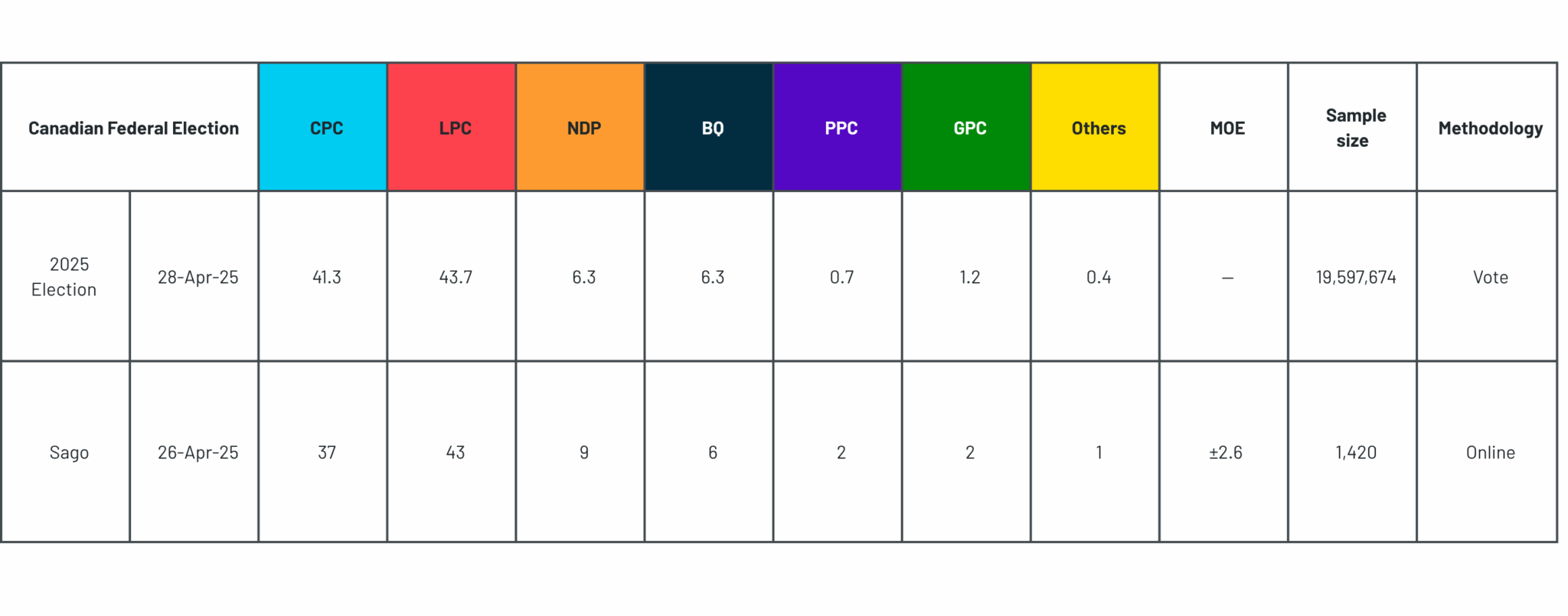
2. Polls conducted during the 2025 Canadian federal election campaign.
While the Sago poll was not released into the public domain, it is compared to those polls taken in the final days of the campaign with a similar field timeframe. Based on the list of 15 polling companies that fit into this category, the Sago poll ranks 8th most accurate and with an average difference in aggregate results of 1.5%.

![[OnDemand] AI Moderation on QualBoard: A Live Look at What's Possible](https://staging.sago.com/wp-content/uploads/2026/02/cherrydeck-CRJMa0Ke7Tk-unsplash-scaled.jpg)

![[OnDemand] Ask Me Anything: Market Research in 2026 with Steve Schlesinger and Melanie Courtright](https://staging.sago.com/wp-content/uploads/2026/01/microsoft-365-oUbzU87d1Gc-unsplash-scaled.jpg)