





 9 Minutes


Key Takeaways
- August is the peak vacation month in key European markets like Spain, Italy, and France, significantly impacting participant availability. Market researchers should adjust timelines and recruitment strategies to account for potential delays and reduced response rates during this period.
- To maintain participant engagement during vacation-heavy months, tailor incentives and outreach strategies to align with regional holiday habits and specific demographic trends. This ensures studies remain on track despite seasonal distractions.
- Understanding local vacation patterns and being flexible with research timelines can mitigate the impact of summer absences. Adjusting schedules, leveraging online research, and planning around key holidays helps maintain data quality and project momentum.
Summer is here, and Europeans embrace it in different ways. Our Omni survey conducted in July 2024 with 5,000 respondents from Germany, Spain, France, Italy, and the UK, uncovered a clear trend: August is the top month for holidays across these markets. In France, Italy, and Spain, about one-quarter of the population takes time off in August, with figures reaching 24%, 27%, and 29%, respectively. The data also shows that younger age groups are more likely to take a holiday in August, while older age groups tend to prefer different times of the year or take fewer vacations overall.
Given these trends, it’s important for market researchers to navigate the summer landscape with a keen eye on regional vacation habits. Adapting strategies to fit local holiday patterns and planning outreach efforts with these in mind make a significant difference in participant engagement and help manage the effects of summer absences.
Here’s how to adapt to summer’s unique challenges.
1. Plan for Reduced Availability
August marks the height of the vacation season across Europe, which can significantly affect recruitment and participation in market research. In the key markets analyzed, the percentage of people taking holidays in August is strikingly high.
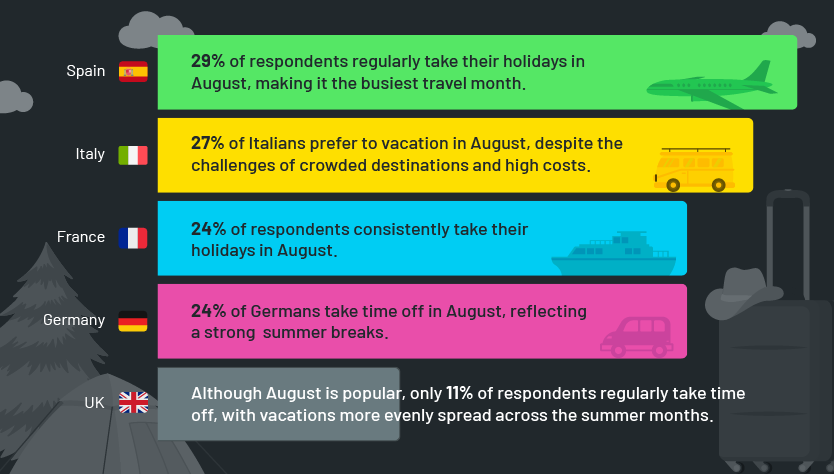
Considering these patterns, adapting your research timelines and strategies to the high holiday activity in August can help ensure your projects remain on track. Planning ahead and allowing for flexibility will make it easier to manage the impact of this busy period.
2. Tailor Incentives and Reminders for Greater Engagement
Summer often pulls people away from their routines, so adapting your approach to keep participants engaged is a good option. Tailoring incentives and reminders to align with participants’ summer habits helps enhance response rates.
For instance, in the Southeast of England, 12% of respondents consistently take their holidays in August, with this trend being especially pronounced among those aged 35-54. To connect effectively with this group, consider crafting region-specific incentives and scheduling your reminders around their vacation schedules. By aligning your outreach with their summer lifestyle, you can maintain engagement even when they’re soaking up the sun.
3. Be Flexible with Research Timelines
Being flexible with your schedule can also improve results during the holiday season. For instance, if you initially planned to complete your study in four weeks, it might be wise to extend it to six weeks. This extra time helps accommodate potential delays and interruptions caused by people being on vacation.
Imagine you’re running a study on rare disease treatments that needs input from specialists in a niche field of medicine. During the summer, when many of these experts are away on vacation, it might become incredibly challenging to secure their participation. Even a 10% drop in availability, given how difficult it already is to reach these specialists, can impact your study. Extending your research timeline gives you the extra cushion needed to overcome this, ensuring you still connect with the right voices and maintain the depth and quality of your findings.
And, of course, there’s always more to consider! Europe’s holiday habits are as diverse as its landscapes. While some regions are bustling with everyday activity, others are completely in vacation mode. To keep your research on track, tailor your approach to fit each country’s holiday patterns. Understanding local habits will help you craft a plan that works with regional trends:
Italy: How to Plan Around Ferragosto
In Italy, Ferragosto, a public holiday celebrated on Aug. 15, triggers a significant increase in vacation activity. It is a time when many Italians take extended vacations, leading to widespread closures and reduced availability in various sectors. The holiday marks the height of summer in Italy and is associated with relaxation, family gatherings, and travel. Younger Italians, particularly from Southern regions, are drawn to August for relaxation (50%) and family time (49%).
France: How to Plan Ahead for August’s Slowdown
In France, August is known for “les grandes vacances,” which translates to “the great holidays.” This is when many people in France take extended vacations, enjoying everything from beachside retreats to countryside getaways. According to our data, about 24% of French respondents go on holidays in August. In comparison, only 9% take time off in June and 13% in July. French people use this time for extended breaks, enjoying beachside retreats and countryside getaways.


Germany: How to Plan for Varied Holiday Schedules
Germany sees the highest vacation rates in August, with 24% taking time off. Notably, 16% are consistently on holiday and 28% often take time off. In contrast, vacation rates drop in June (4%) and September (7%). Overall, August is the most popular month for vacations, with younger individuals and those in Southern Germany especially likely to be on holiday then.
Spain: Prepare for the August Surge
Spain leads with 29% of the population regularly taking holidays in August, and another 30% frequently vacationing. The main motivations are to unwind (52%) and spend time with family (43%). This trend sharply declines in September to 11%. To effectively manage this period of heightened travel activity, plan your recruitment efforts for June and early July. Implement targeted communication strategies and offer incentives or flexible participation options to address the high number of absences.
United Kingdom: How to Navigate the August Break
Given the UK’s more evenly distributed vacation periods from June to September (August standing out with 11% of people regularly taking time off), market researchers have the advantage of accessing British consumers throughout the summer.
So how can you plan around this?
- Recruit Early: Focus recruitment efforts in June or early July to avoid the August vacation peak.
- Offer Flexibility: Use asynchronous or flexible participation options to accommodate those traveling.
- Tailor by Region: Pay close attention to country-specific trends (like Ferragosto in Italy or extended August breaks in France and Spain) to adjust timelines and expectations.
- Target Younger Demographics Wisely: In some regions (like Southern Italy or Germany), younger participants are more likely to be on vacation in August.
- Use Targeted Communication and Incentives: Implement targeted communication strategies and offer incentives to address the high number of absences and maintain engagement during peak vacation periods.
4. Focus on Online Research, But Manage Expectations
Turning to online research is a savvy choice for connecting with participants during the summer. However, keep in mind that responses may be less detailed—travelers might encounter spotty Wi-Fi or have less patience for lengthy interviews. With Sago’s platforms and top-notch tech support, you can streamline your research process. By offering flexible response options and utilizing Sago’s advanced technology, you’ll enhance your ability to gather meaningful insights even while participants are enjoying their summer breaks.
Final Thoughts…
Addressing the challenges of market research during Europe’s summer holiday season requires more than just timing; it’s about smart planning and local insight. Each country presents its unique landscape, from Italy’s Ferragosto to France’s “les grandes vacances.” In Germany, the mid-July to late August period sees reduced availability due to school holidays, making it crucial to plan accordingly if your project involves professionals like physicians. Similarly, in Spain, August is a particularly heavy vacation month, making it essential to start recruitment early.
Think of it as setting a strategy to navigate a crowded beach—knowing when and where to focus your efforts can make all the difference. By anticipating regional vacation trends, customizing your approach, and allowing for flexibility, you can successfully steer your research through the summer months and achieve meaningful, reliable results.

![[OnDemand] AI Moderation on QualBoard: A Live Look at What's Possible](https://staging.sago.com/wp-content/uploads/2026/02/cherrydeck-CRJMa0Ke7Tk-unsplash-scaled.jpg)

![[OnDemand] Ask Me Anything: Market Research in 2026 with Steve Schlesinger and Melanie Courtright](https://staging.sago.com/wp-content/uploads/2026/01/microsoft-365-oUbzU87d1Gc-unsplash-scaled.jpg)