





 13 Minutes


Understanding what truly drives consumers to choose organic or locally produced foods requires looking beyond assumptions and into real behavior. To do this, we surveyed 7,000 consumers across seven countries, asking them how they shop, which labels they trust, how often they buy organic or local products, and what they’re willing to pay for them. The responses paint a clear picture: while health, nutrition, and trust in certified labels play a major role, consumers’ priorities shift significantly by country, influenced by cultural expectations, economic pressures, and perceptions of quality. This blog unpacks how these factors shape shoppers’ actual purchasing decisions.
This analysis is based on a survey conducted in October 2025 in the United States, Mexico, and five European countries: the United Kingdom, Italy, France, Spain, and Germany.
A total of 7,000 people were surveyed, or approximately 1,000 respondents per country, providing a robust and representative comparative view of purchasing behaviors.
Key Takeaways
- The origin of production is a key factor in purchasing decisions in the food sector, particularly when associated with organic certification, which is a guarantee of quality and trust.
- Official labels are generally viewed positively, provided that brands communicate transparently and provide clear evidence of their commitments.
- Price remains a key factor in purchasing decisions: consumers are willing to favor local or organic products, provided that the price difference compared to a conventional product does not exceed 5%.
In this Article
- Health, Nutrition, and Price: Key Criteria
- Purchase Frequency: Organic, Local & Conventional Products
- The Price Issue: Varying Sensitivity Depending on the Country
- Trust In the Various Labels
- Local Production: Local Products and Short Supply Chains
- Organic Certification & Environmental Impact
- Labels Associated with Brands
- Why Do Consumers Trust Official Labels?
- Labels to Be Used by Brands
- The Most Reassuring Label for Today’s Food Shoppers
- What Should Brand Marketers Focus On?
Looking to get similar insights?
Today’s consumers live in an environment where food offerings are vast and sometimes complex. Between conventional products, organic options, foods sourced locally, or combining local production and organic farming, there are many choices.
In this context, understanding the criteria that guide purchasing decisions becomes essential for stakeholders in the agri-food sector.
The omnibus survey analyzes consumer behaviors, expectations, and barriers regarding organic and local products.
Health, Nutrition, and Price: Key Criteria
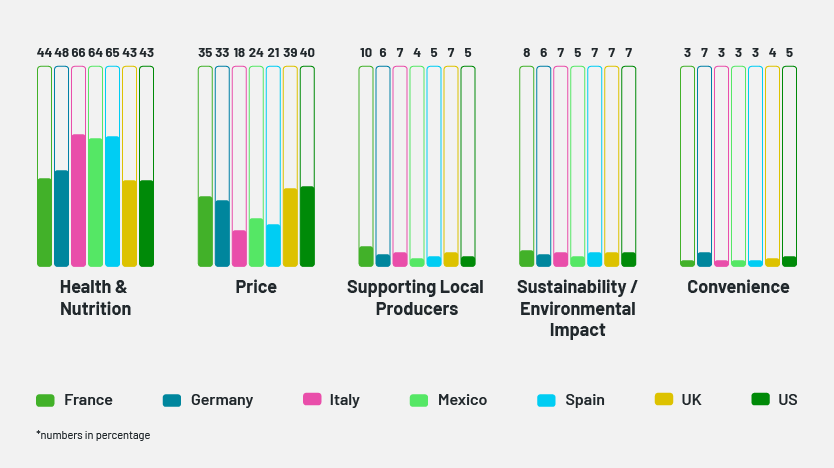
In each country, five factors were ranked in order of importance:
- Health and nutrition
- Sustainability and environmental impact
- Supporting local producers
- Price
- Convenience.
Regardless of their nationality, respondents rank health and nutrition as the top priority in their purchasing criteria. This factor is even more important given that consumers today are looking for high-quality products that are rich in nutrients and beneficial to health. They want to avoid foods containing potentially harmful chemicals or additives.
It should be noted that two consumer profiles are emerging:
- Countries most concerned about health: Italy (66 %), Spain (65 %) and Mexico (64 %).
- Countries where other criteria, especially price, carry more weight: France (44 %), Germany (48 %), United States and United Kingdom (43 %).
Price appears to be a decisive factor, particularly in English-speaking countries, France, and Germany. The rising cost of living is intensifying this financial sensitivity.
Price is a key criterion for 33 to 40% of respondents, whether they are English-speaking, German, or French. Against a backdrop of widespread increases in the cost of living—food, energy, taxes—purchasing power is becoming a key concern. Consumers sometimes base their choices on price, without compromising on quality.
For other countries, the price factor is significantly less important (less than 24%).
Although criteria such as environmental impact, support for local producers, and convenience are taken into account, they are not the primary drivers of decision-making. In a tense economic climate, purchasing power strongly influences choices, with priorities varying from country to country.
Purchase Frequency: Organic, Local & Conventional Products
Let’s look at the frequency of purchase of three categories of food products over the last month:
Conventional or Non-organic Products
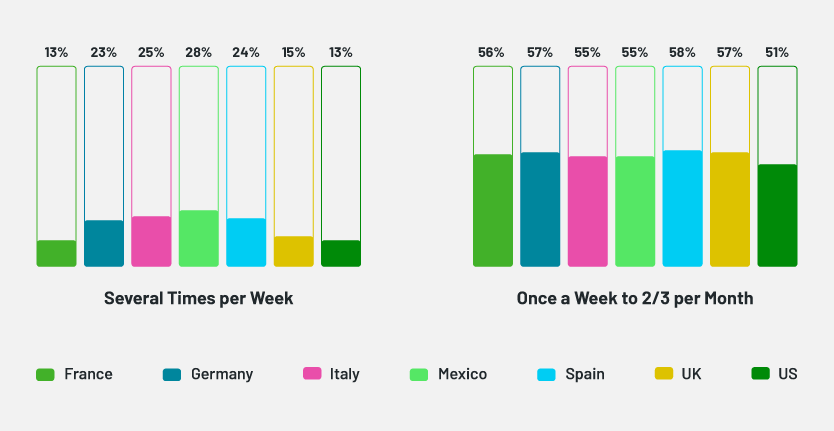
Unsurprisingly, conventional products remain the most frequently purchased, often several times a week.
Local Products
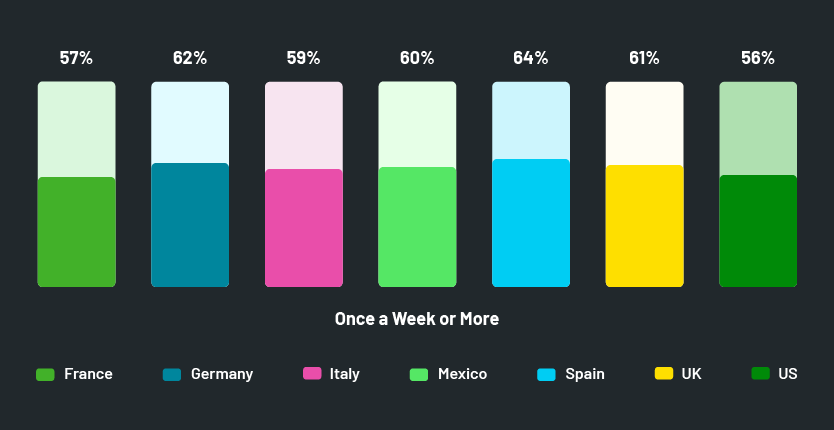
Local products are purchased more frequently than expected: local products are purchased particularly regularly, especially in Germany, Italy, Mexico, and Spain.
Even though local production is not always a priority criterion in purchasing decisions, it remains important to consumers: very few say they do not buy local.
Non-consumption rates are extremely low—around 3 to 5% in Germany, Italy, Mexico, and Spain, and only 11 to 15% in other countries—confirming the general commitment to supporting local producers.
Organic Products
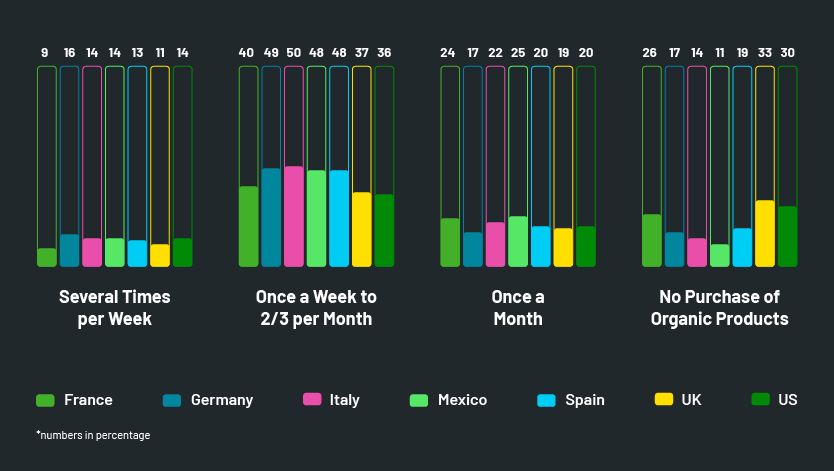
Two general country profiles stand out in terms of organic product consumption:
- On the one hand, Germany, Italy, Mexico, and Spain, where consumers buy organic products more regularly, at a frequency of around once a week.
- On the other hand, France, the United Kingdom, and the United States, where the frequency is lower—one to three times per month—and where a quarter to a third of consumers say they do not buy organic products.
As a result, consumption of organic products remains moderate in certain countries, particularly in English-speaking markets and France.
This trend can mainly be explained by the perception of a higher price compared to conventional products, due to higher production costs. It sometimes adds to significant regulatory constraints, as in France, where producers must comply with strict national and European standards.
The Price Issue: Varying Sensitivity Depending on the Country
Consumers have clearly indicated—in some countries more strongly than in others—that price remains a determining factor in their purchasing decisions. When the same product is available in organic or local versions, a question arises: Are they willing to pay more?
The answer is generally positive, but with significant differences between countries:
- Strong to very strong acceptance: Italy (69 %) and Mexico (72 %)
- Moderate acceptance: Germany (55 %), France (58 %) and Spain (61 %)
- Low acceptance: United States (54 %) and United Kingdom (50 %)
When a price increase is considered, most consumers fall within a very limited range, mainly between 1 and 5%.
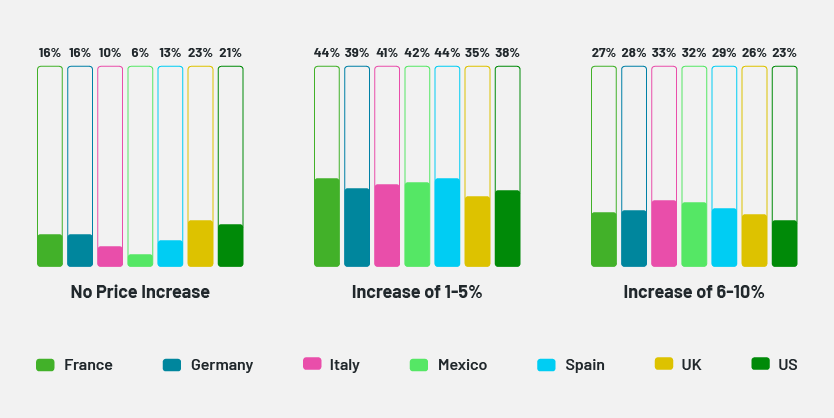
We can see that countries with Latin-based languages (Italy, Spain, France as well as Mexico) are more inclined to accept a price increase than English-speaking countries (United States, United Kingdom), where price sensitivity is more pronounced.
These differences partly reflect differences in economic conditions: in some countries, purchasing power is under greater pressure, which limits the ability to accept even a moderate increase.
To sum up, consumers are indeed willing to pay extra for organic or local products, but only within reasonable limits, which are heavily influenced by their purchasing power and the country’s economic situation.
Trust In the Various Labels
Several labels were evaluated to measure consumer confidence and their potential influence on purchasing decisions:
- “Organic” certification
- “Local product”
- “Sustainable” or “eco-friendly”
- “From farm to fork” / directly from producer
- A brand’s own sustainability claims.
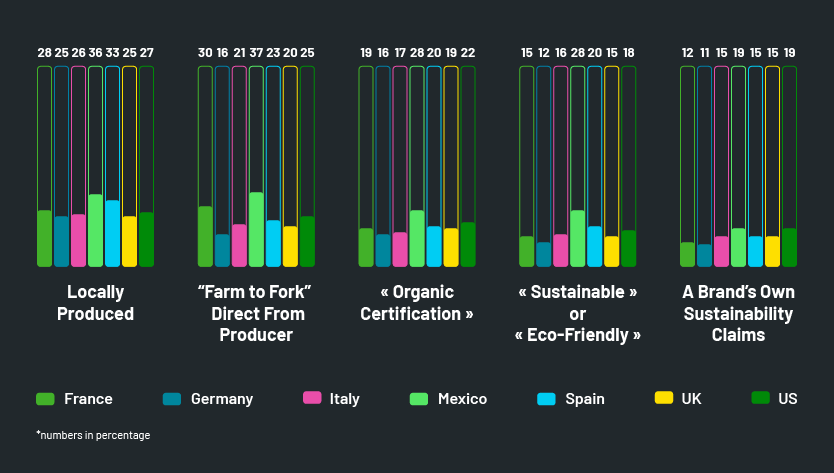
Local Production: Local Products and Short Supply Chains
Regardless of the country, consumers tend to trust products labeled as “locally produced” more, especially when they are genuinely made locally or sourced directly from the producer.
Local labels are predominant because they evoke proximity, traceability, and transparency. The shorter the production chain, the greater the trust.
This confidence can be explained by the fact that buying directly from the producer, or favoring short supply chains, promotes a better opinion and is a more reassuring purchase, linked to greater transparency regarding the origin of the food. The longer the chain from the food’s origin to its sale, the greater the mistrust will be.
Although local production is not cited as the primary purchasing criterion, it plays a key role in consumers’ trust in labels.
Organic Certification & Environmental Impact
It is important to note that organic certification remains a major benchmark for consumers, particularly in countries such as Germany, Italy, Spain, and the United Kingdom, where it has a high level of trust.
The criterion “sustainable/eco-friendly” generally ranks fourth but is nevertheless well perceived. It is even a particularly powerful lever in Mexico, where concerns about environmental protection and biodiversity are more pronounced.
In several countries (notably Germany, France, the United States, and Mexico) the perception of sustainability is very similar to that of organic certification. This is because the two concepts are closely linked: organic products are based on regulated, environmentally friendly agricultural practices and are often associated with a sustainable approach.
In short, organic and sustainability go hand in hand in consumers’ minds, reinforcing their trust in products that combine both aspects.
Labels Associated with Brands
Brands’ sustainability claims are significantly less valued compared to the other items above. This perception can be explained by the fact that consumers place more trust in information from more official bodies than in the brands themselves.
This is because brands are sometimes perceived as less credible than local producers, due to the sometimes-unclear origins of their products or an image focused on profitability rather than ecological/organic/health commitments. Furthermore, a lack of transparency regarding production processes can reinforce this mistrust.
Brands should rely on official labels issued by health or government agencies and demonstrate their commitments in concrete terms to positively influence purchasing decisions.
Why Do Consumers Trust Official Labels? 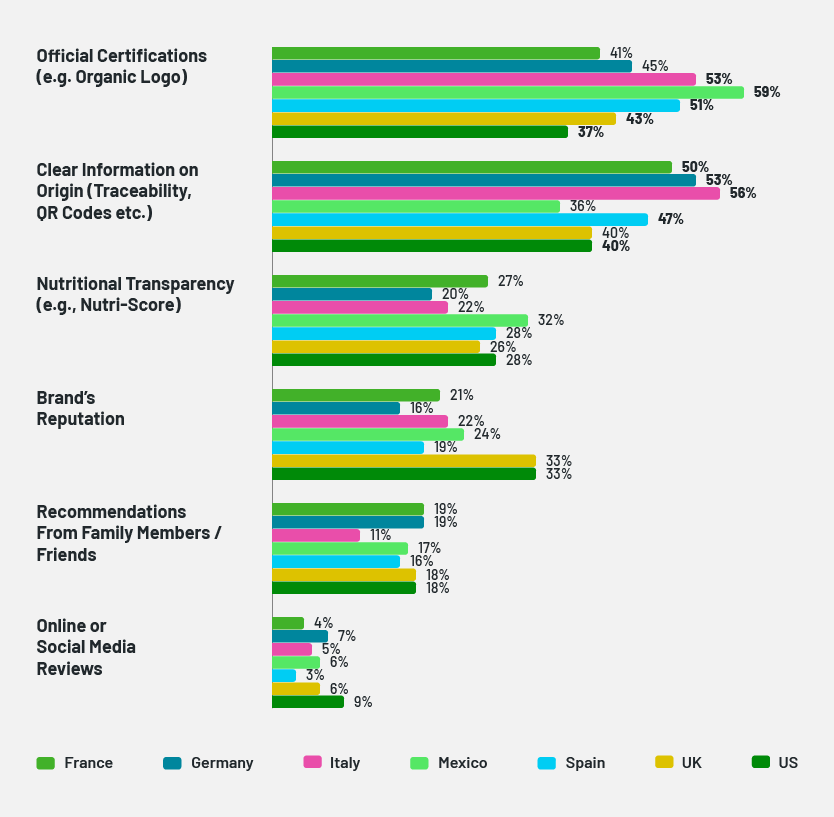
Consumers place greater trust in clear information about the origin of food or in official organic certification. The more accurate, transparent, and recognized the information obtained for a food product is, the stronger the intention to purchase that product will be.
The nutritional value of a food product is less important than information about its origin or traceability, which are perceived as proof of reliability. This trend can be explained by the lack of clarity and accessibility of nutritional data: interpreting it is not intuitive for many consumers, due to sometimes limited understanding or unclear presentation.
Only English speakers report placing greater trust in a brand’s reputation (33%) compared to other countries (less than 25%).
Recommendations from family or friends, as well as reviews circulating on social media, are generally not considered reliable sources of information, regardless of the country.
However, there is one exception: younger generations, who place greater trust in online reviews and content shared on social media.
Labels to Be Used by Brands
Consumers believe above all that brands need to communicate better about the origin and certification of their organic products, as well as their location. According to them, it is essential to be precise to inspire confidence and encourage purchases.
Brands should therefore prioritize the use of official labels or those recognized by consumers, while providing concrete evidence to back up their claims.
However, it is important to use eco-friendly, local, or sustainable claims sparingly so as not to lose consumer trust, particularly in France (25%), Germany (31%), the United Kingdom (24%), and the United States (25%). It is therefore crucial to focus on those that have the greatest impact.
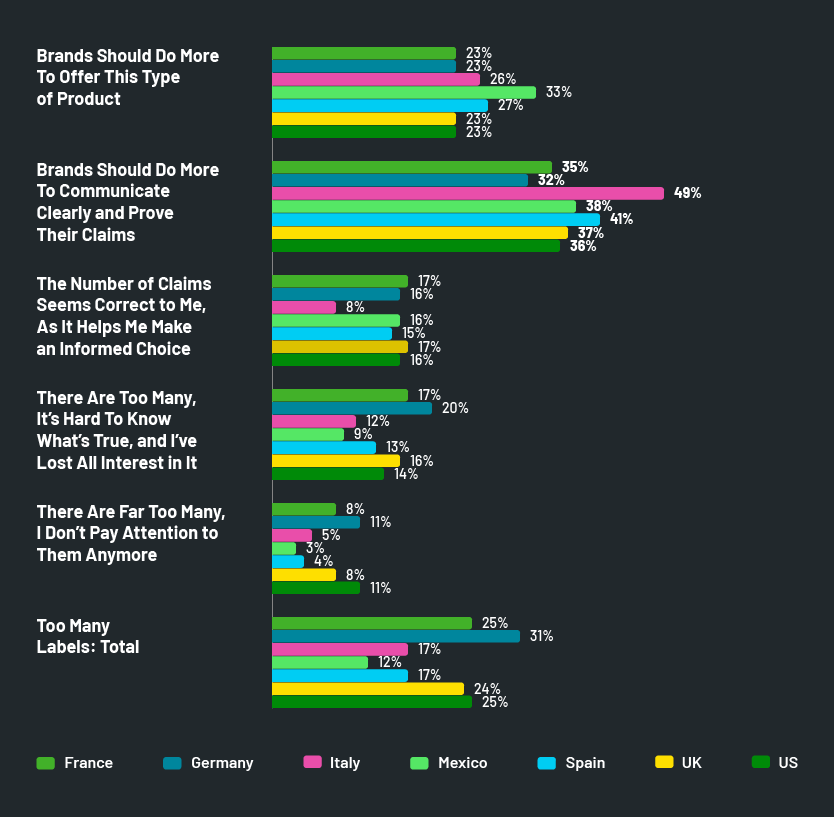
And, of course, brands must continue or do more to offer more “local” and “organic” foods, while keeping in mind the essential effort required to clearly communicate their claims.
The Most Reassuring Label for Today’s Food Shoppers
When making a purchase, between 67% and 84% of consumers, depending on the country, pay attention to the origin of food and/or its organic label.
For consumers, local production is often associated with foods of higher quality, both nutritionally and in terms of health.
However, behaviors vary from country to country:
- France, Italy, and Spain: local origin is given greater consideration.
- Mexico and the United States: the organic label is mentioned more often.
- Germany and the United Kingdom: both criteria are seen in similar proportions.
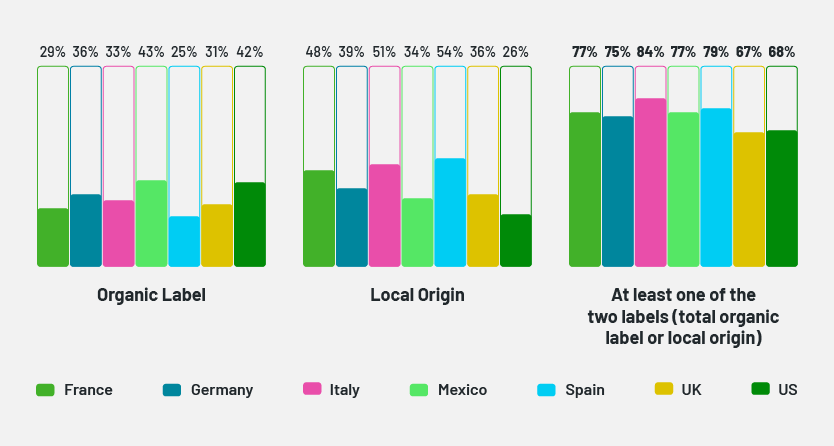
Note: Nearly one-third of consumers in the United Kingdom and the United States do not look at either of these labels or consult any information when making a purchase.
In practice, buying a local product has a stronger impact in the eyes of consumers, especially when it is associated with an organic dimension. The standards governing this type of production vary from country to country, which can raise questions. In this context, buying locally appears to be a reassuring solution, combining proximity and organic requirements.
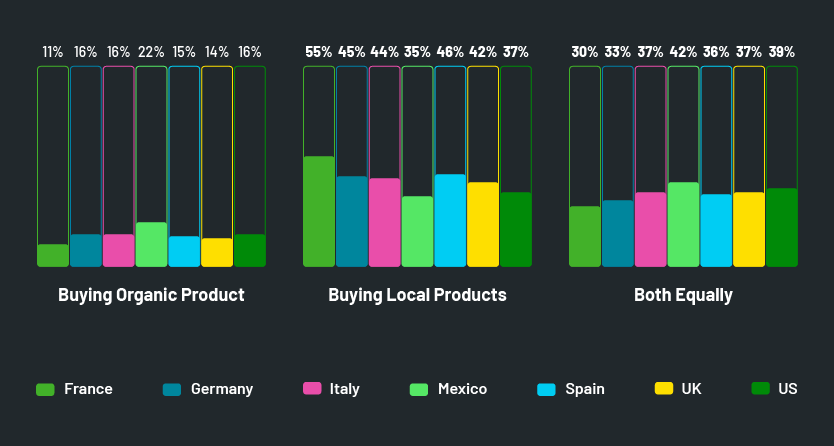
Where Should Food Brand Marketers Focus?
1. Highlight Local Origin and Organic Products
- Emphasize the link between geographical origin and perceived quality since local and organic products are perceived as more nutritious.
- Develop engaging storytelling and content like videos or producer testimonials.
- Organize local partnerships and events to reinforce authenticity.
2. Offer Transparency on Quality and Labels
- Communicate clearly and transparently about organic certifications and quality standards.
- Provide tangible proof: audits, analyses, traceability.
- Create a dedicated space for transparency on packaging and digital channels.
3. Examine the Impact of Price Accessibility
- Adjust prices according to local purchasing power.
- Offer smaller formats and regular promotions / attractive bundles.
4. Measure Impact on a Consistent Basis and Adjust Accordingly
- Validate actions through market research.
- Track KPIs: perceived quality, trust in labels, price sensitivity, purchase intention.
In summary: The trend is to produce more locally while controlling costs to offer quality products at an affordable price, with transparent communication about certifications and origin.

![[OnDemand] AI Moderation on QualBoard: A Live Look at What's Possible](https://staging.sago.com/wp-content/uploads/2026/02/cherrydeck-CRJMa0Ke7Tk-unsplash-scaled.jpg)

![[OnDemand] Ask Me Anything: Market Research in 2026 with Steve Schlesinger and Melanie Courtright](https://staging.sago.com/wp-content/uploads/2026/01/microsoft-365-oUbzU87d1Gc-unsplash-scaled.jpg)